1931 - today

Best of Both Worlds

The worst economic downturn in U.S. history, the stock market crash of 1929, seized the nation just about three years to the day after Northfield became a town. But it cast barely a ripple among farmers here, said Henry Seul to the Winnetka Talk in 1973. “Most Northfielders were still farming, so we didn’t want for food,” he said.

Ground had by now been broken for the new Sunset Ridge School, still one year away from opening. “By the time we moved into the new school, everyone was broke,” recalled
Julia Cray Kennedy, whose father, principal William Cray, had to take a pay cut in 1931 from $240 to $215 a month.

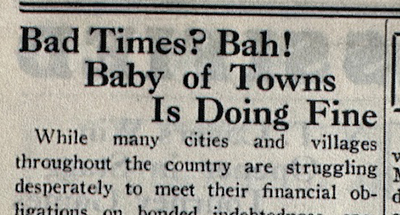
But our newly-launched village, now with a population of 300, stayed above the fray. Here’s how the Winnetka Talk in 1931 described the impact of the Depression on Northfield in Bad Times? Bah! Baby of Towns is Doing Fine.

“While many cities and villages throughout the country are struggling desperately to meet their financial obligations… Northfield—ust west of Winnetka and the youngest village in Cook County—is ‘sitting pretty,’ from a financial viewpoint,” the Winnetka Talk said.

“This secure position of Northfield has prevailed since its incorporation a few years ago… thanks to the conservative, cautious administration of village affairs.”

The article then gave an example of the fiscal restraint our village board used when it had to secure $200,000 in bonds to install water mains to bring in water from Winnetka:

“At the time water mains were installed in Northfield, some villages advocated immediate construction of a sewer system, street paving and more sidewalks,” the Winnetka Talk said. “The more conservative like Northfield, however, counseled moderation in expenditures, on the theory that it is safer to buy one thing at a time, or only what it was certain the village could pay for.”

In this more sober era, a town once ridiculed as backwoods and behind-the-times suddenly looked savvy.

And those “super suburb” champions? The business model that had worked so well for Insull and Nixon in Westchester—a town that willingly bent to their aggressive growth plans—proved not a good fit for Northfield.

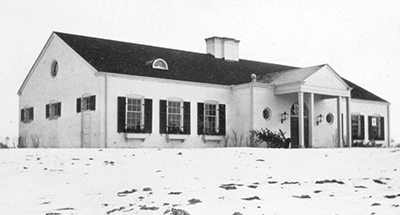
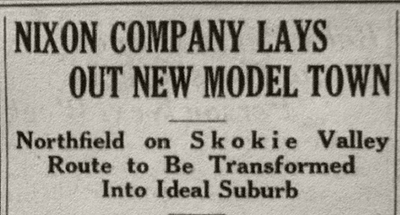
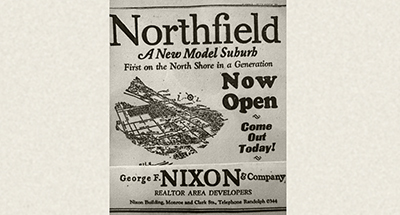
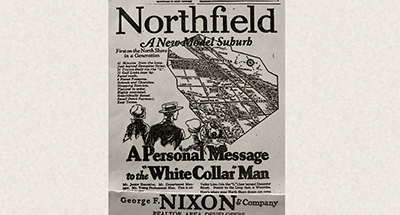
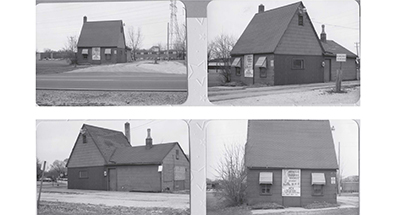
The year 1929 marked the last time Nixon bragged about his “super suburb.” In March of that year, he told the Winnetka Talk he expected to build 50 more homes along Bosworth Street by late summer 1929. It never happened. The four model homes he had already built and showcased on DIckens Road, just south of Bosworth, stood alone for years in a subdivided area dotted only with sidewalks and utility poles.

A final farewell

Board minutes in January 1931 show the signs of a rupture. Nixon and insull had always paid for street lighting in neighborhoods they were developing, as part of their pact with Northfield. But that month, the village attorney was instructed to inform Insull’s firm, the Public Service Company, that Northfield, “will not be responsible for electric light bills and that they must discontinue the service at the end of the present arrangement with George F. Nixon and Company unless they can make their arrangements to have persons who have been paying the bills continue to pay them.”

Then, in October 1932, the board—now led by Bernard Schildgen, not a Nixon fan—signed a “declaration of vacation” with Chicago Title and Trust Company on Nixon’s subdivided lots, a clear sign he had vacated his investments here.

Nixon’s name never again appeared in board minutes. Trustees also changed their meeting site. Still without a village hall, they moved Northfield’s “municipal headquarters” from Nixon’s real estate offices to the basement of trustee Fred Haut.

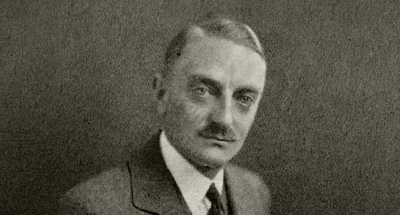
Nixon did survive the Depression. His efforts with Insull in Westchester may have slackened during the Depression, but he stayed active there. In 1931, the town proudly named its elementary school after Nixon on land he donated. It still stands today. Nixon also enjoyed a successful second act in Westchester in the late 1940’s, selling real estate during the post-World War II housing boom. Today, the town honors him as a visionary.

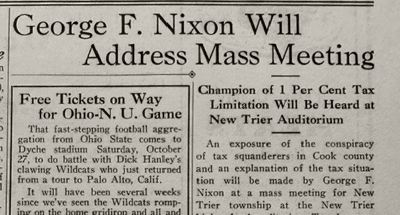
About the same time Nixon severed ties with Northfield, he gained stature throughout the North Shore when he was elected in 1932 to the Cook County Board of Tax Appeals. Then, in 1941, he became the first president of the National Association of Home Builders. Locally, he was featured in 1934 on the front page of the Winnetka Talk as featured speaker at a mass meeting he organized at the New Trier high school auditorium on the need to reduce property taxes, promising “a speech full of fire and facts… of vital interest to every resident of New Trier township.” He died at age 83 in 1976, his reputation intact as an industry legend who built more than 3,000 homes.

Why Nixon split

But he was never again seen in Northfield. Why? Perhaps Nixon pushed our town too far. He had brought to Northfield, with great fanfare, everything he’d learned from his earlier projects. However, his “scientific” approach to creating a “super suburb”—plus all the hype—proved too much for locals. Our town may have appeared to Nixon as an outpost of gullible rubes; but this perfect, scientifically engineered suburb he was trying to sell, and sought to control, turned out to not be the Northfield locals wanted. When Nixon felt the heat of the 1929 financial downtown, our town didn’t step up as a partner to save or help him, and the Depression quickly hastened his exit.

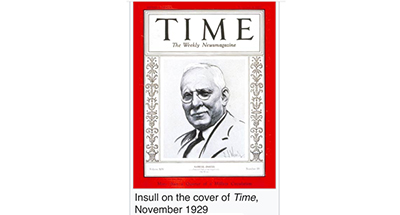
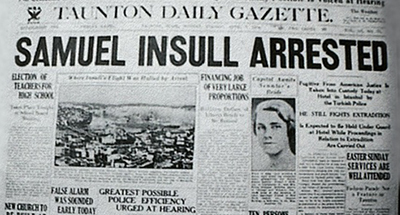
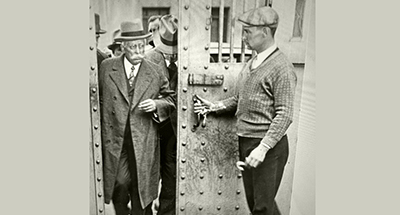
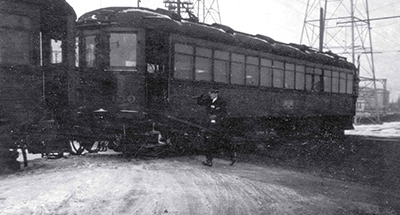
Samuel Insull was a different story. He died penniless and a broken man in 1938 in a Paris train station. At heart, he was a good man, generous to both his employees and the greater Chicago community. During the lean years of the Depression, he kept his $4 billion empire going by indulging his appetite for risk-taking with heavy borrowing. He stayed afloat until 1932. Insull’s downfall? He was a loner who liked to do things his way, devising intricate financial maneuvers to structure his light, gas and streetcar companies. And sometimes, he made enemies.

For example, Insull hated the New York banking establishment. He saw its ruthlessness when he was a young man working for Thomas Edison, and he watched J.P. Morgan, one of Edison’s chief financiers, ruin the great inventor by coercing the merger of his company, Edison General Electric, with a competitor, and then stripping Edison’s name from the new firm it renamed General Electric.

Insull vowed to never deal with New York bankers again. But in 1932, his hand was forced when his risky Depression-era borrowing sprees finally caught up with him. His losses were massive, and he had no choice but to put himself at the mercy of New York’s banks to help him. They refused, and instead launched a cutthroat campaign to discredit him, forcing him into bankruptcy.

This was especially bad news for the 600,000 Americans who had invested with Insull, their losses totaling some $600 million. Among them was Northfield’s Elizabeth Levernier. She was never repaid the $800 she invested in Insull’s bonds, and she told this author in 1967 that she felt scammed. The outcry of ordinary citizens like her prompted Franklin Roosevelt in 1932 while on the presidential campaign trail to make a public mockery of Insull, blaming monopolies like his for causing the Depression, and fleecing investors, all of which led to stricter regulations and disclosure laws in 1935 for public utilities.

Insull’s legacy to Northfield

Most of Insull’s land holdings in Northfield were sold off in the 1930’s by creditors. How did he ultimately impact our town? Clarence Seul, grandson of pioneer Henry Seul, said to the Winnetka Talk in 1974: “Insull was a great man at the time. The whole town thought highly of him. He put the electric line through. He bought up a couple hundred acres where Bess Hardware is now. He put in sidewalks, and then the crash came and that was the end of that. I am glad (his plans) didn’t go through. He would have broken our land up into small lots, and Northfield would have been just another development, instead of the way it is now.”

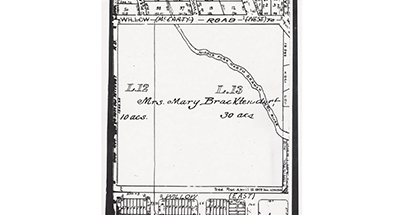
It is significant that Insull’s land, originally owned by Mary Brackendorf, is today owned by Northfield’s Park District and is also the site of Middlefork School. Throughout the decades after Insull left, that land just sat there, unoccupied, but still zoned for small lots just the way Insull and Nixon envisioned.

As Northfield grew in the 1950s, however—its population tripled in that decade to 4,000 with the opening of the Edens Expressway—rumors started circulating about the reappearance of George Nixon or another developer. What happened next was an intervention that could only happen in Northfield.

As the rumors swirled, a group of Northfield dads got together in 1955 to figure out how to stop any developer who might build on those bucolic acres, changing the look and feel of their town. “It was a boxcar a—rrangementnothing good,” recalled Bill Bacon, a Northfielder who spearheaded the effort, calling upon his friends.

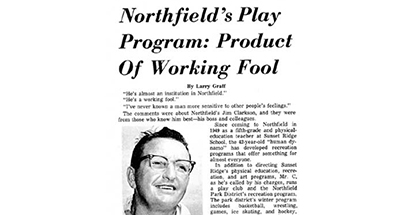
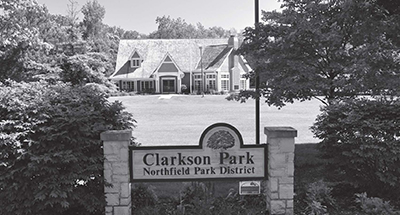
They came up with the idea of forming a park district. And why not? Winnetka had enjoyed one since 1904. Northfield was just getting by, using the basement of Jim Clarkson, Sunset Ridge School physical education teacher, to store an array of sports equipment. This new plan gave them the legal right to condemn the land—a 28-acre parcel where Middlefork School and Willow Park are today—keeping it out of the hands of developers.

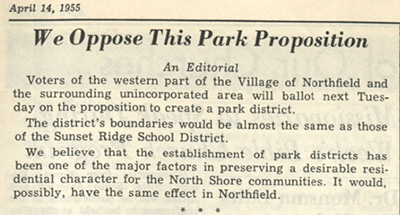
The idea was ridiculed by the local press. “We Oppose This Park Proposition,” the Winnetka Talk said in April 1955, citing Northfield’s scheme to quash residential development by forming a park district “as invalid an excuse for the establishment of a park district as we have ever heard.”

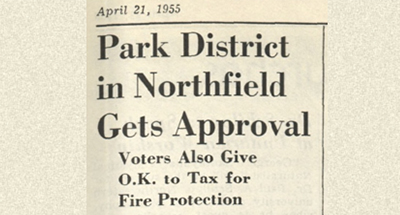
But Northfield voters ignored the press pundits, and the dads prevailed. Land formerly owned by Lucy Brackendorf’s mother Mary—and later passed on to Tom Wagner, who married Lucy’s sister, and then purchased and subdivided by Samuel Insull—was eventually purchased by the local dads and set aside for a park and school through two referendums that first, formed Northfield Park District, and second, made available $200,000 in bonds to buy and develop the land. Our school District 29 also purchased five acres of the land to build Middlefork School, which opened in 1959.

Partners and pioneers

No other North Shore town had seen anything like it, and the partnership between our park district, school and village has now flourished for 70 years. It’s something special about Northfield.

“I remember driving through Northfield years later, and being amazed,” recalled Bill Bacon, who left Northfield soon after both referendums passed. “Here was this beautiful new school next to a park with a lot of improvements. Obviously, Northfield’s village, park district and school joined forces and did a very good job. “That housing plan we battled,” he added, “would have changed the town.”

Still, in the decades leading up to that landmark pact, nothing in Northfield came easily. When the dream of a “super suburb” vanished, how did our town in 1933 recover?

In a word: alcohol. Prohibition laws—lasting from 1919 to 1933—were lifted just as our town was figuring out ways to grow.

Temperance had always been a proud virtue on the North Shore. Winnetka, when it was formed in 1869, wrote an alcohol ban into its village charter. Evanston, home of the Women’s Christian Temperance Union, led the nation as the “birthplace of Prohibition”; and Northwestern University, which forbid liquor sales on campus, also banned alcohol within four miles of the university.

Even after Prohibition was repealed, Winnetka, Evanston, Wilmette, Kenilworth and Glencoe all stayed dry. It wasn’t until the 1970s that Evanston finally allowed alcohol sales, and other communities followed.

Not in Northfield. Just two months after Franklin Roosevelt signed the Cullen-Harrison Act in March 1933—the nation’s first step in repealing Prohibition—our trustees unanimously approved Northfield’s most detailed law to date, Ordinance #43, addressing, “the manufacture, possession and sale of malt and vinous beverages in the Village of Northfield.”

Two months later, Northfield’s former police chief, Palmer Giambastian, was the first to apply for a license to sell beer and wine. Alex Levernier was second. By November of that year—one month before Prohibition was formally repealed, allowing the sale of all spirits—Northfield had already granted six liquor licenses within the village, initially charging $25 for a six-month license, then quickly raising it to $50. By 1942, fees had risen to $500.

Bar business booms

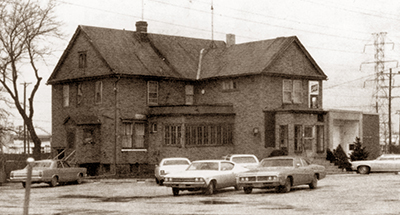
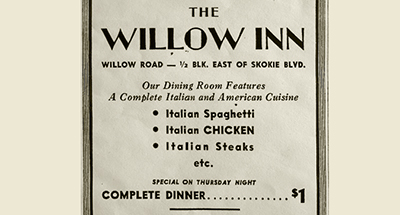
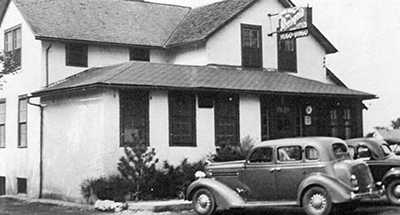
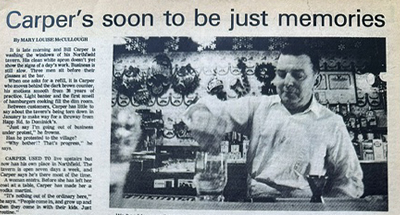
This was a new niche for Northfield. And from that ordinance sprang Hugo’s, Carper’s, the Willow Inn and Seuls. Decades later came The Pub and Danny’s. The only spot still standing is Seuls, which became Stormy’s in 2011. These enterprises gave our rural farm community a whole new look and identity: a little rough around the edges, and fun.

A slightly different perspective was offered by Harry Collins, Sunset Ridge School’s second superintendent, who shared his impression of Northfield when he first came in 1943:

“The most significant thing was that the village had little identity of its own,” Collins told the Winnetka Talk on the eve of his retirement in 1976. “Our school was very much the community center. There was no where else to go,” he said. In fact, he mused, the school was such a popular gathering place, he didn’t even know how many people had keys. “Everybody knew everybody,” he said.

The truth is, Northfield’s identity was a little of both. It now had a showcase school; but the advent of liquor sales in 1933 set it apart as a more rough-and-tumble town than its temperance-minded neighbors. This was fine with locals. When Northfield’s village board held a referendum in 1938, asking: “Shall the sale at retail of alcoholic liquor be prohibited?” locals voted a resounding “no” (107 “no” votes and 40 “yes.”)

There was also a second industry that shaped Northfield’s image after Insull and Nixon vanished.

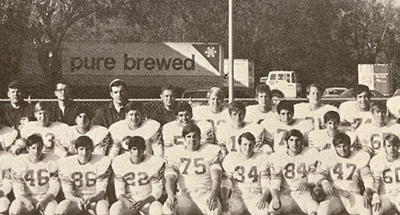
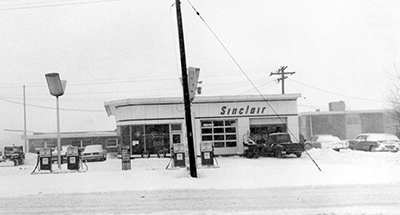
Since the 1920’s, the sight of Alex Levernier’s coal yard on the southwest corner of Happ and Willow, right next to his general store, made Northfield’s downtown look industrial and unkept. Over the next few decades, bulk oil plants that stored and transported large volumes of petroleum products like diesel, gasoline and lubricants found a welcoming home in Northfield. By the 1940s, anyone driving through downtown might see the Pure Oil Company, Peaster Oil, Murphy-Miles Oil, Brown Brothers Oil Company, Deep Rock Oil Company and Winnetka Coal and Lumber.

In addition, by 1943, eight gasoline filling stations operated in Northfield, prompting the village board that year to draft a law to, “regulate the storage, transportation, sale and use of gasoline and volatile oils.” These businesses now dominated Northfield’s downtown landscape. Was this the look we wanted? There was also debate about the number of liquor licenses issued, and our image on the North Shore as the local watering hole.

Finding our way

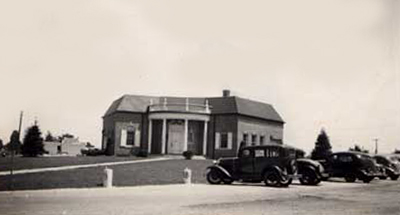
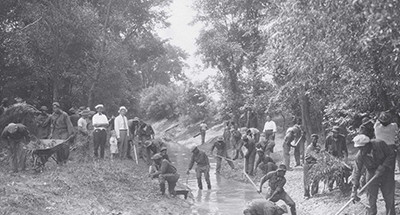
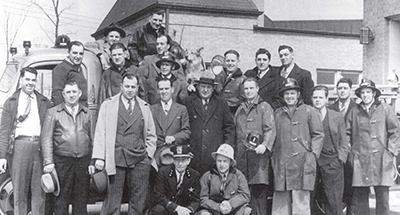
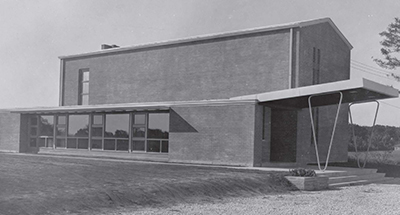
Northfield’s board borrowed $12,000 in 1936 to finally build its own Village Hall, and mapped out plans for a fire station in 1939. It also erased its image as “a swampy bog,” thanks to a high-powered Winnetka neighbor, Harold Ickes. In 1933 he became the U.S. Secretary of the Interior under Franklin Roosevelt, and he devised a ten-year plan to drain the Skokie wetlands. Funded through the New Deal, Ickes’ plan enlisted workers from the Civilian Conservation Corps who spent a decade on a massive land- reclamation project that created the Skokie lagoons.

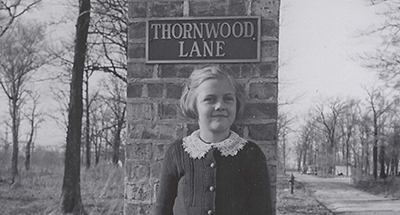
But Northfield was still very remote, recalled Judy Blake Ives, Sunset Ridge class of 1940. Her father was a successful dentist who moved to Northfield from Wilmette in 1933 to build his dream home on a double lot on Thornwood Lane. She remembered going pheasant hunting with him in the open fields where Thackeray, Bosworth and Ingram are today. Their outing was ruined when they ran into a crew of laborers with tractors, mysteriously loading the area’s topsoil into trucks.

The City of Chicago, they later learned, was “borrowing” the dirt for the 1933-34 Chicago World’s Fair.

“I think the city fathers figured: ‘Go to the most remote place you can think of.’ And no one, they bet, would ever live here!” said Ives, who went to the World’s Fair that year, along with 39 million other visitors. “My dad kept reminding me: ‘That’s Northfield soil you’re walking on!’”

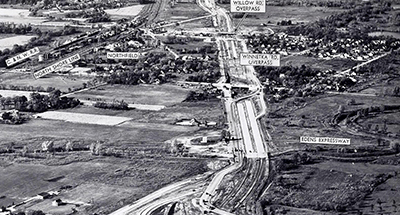
All that changed two decades later, when the Edens Expressway opened in 1951, replacing Old Skokie Boulevard as the major artery through Northfield. The freeway helped usher in the postwar baby boom, and Northfield’s population tripled over that decade to 4,000.

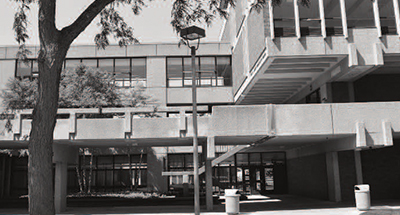
In 1965, another first: 46 acres of the land John Happ first settled in the early 1850’s became New Trier West high school, serving District 203’s burgeoning enrollment, and bringing a best-in-class high school to our town.

These were all levers of growth and progress for Northfield. And a common theme was emerging: in the case of our schools, parks and village, it was always concerned citizens stepping forward to help problem-solve with few resources, and coming up with solutions you just didn’t always find in other towns. Take the library.

How Northfield got a library

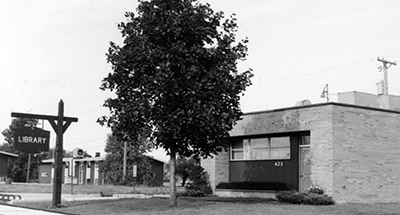
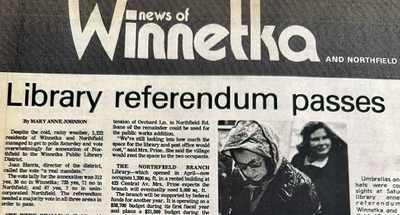
In the 1970s, as buzz around town grew about the need for a local library, a team of 68 Northfield moms got together to launch a “Friends of the Northfield Library” committee. They held a fundraising campaign and, with help from a federal grant, worked side-by- side with Northfield’s Public Works to transform 1,250 square feet of rented office space at 423 Central Avenue into a makeshift library. Public Works tore down walls and rebuilt the space, while local moms cleaned, painted and decorated, in addition to typing all the catalogue cards for 3,000 books. A grand opening was held in April 1974.

Just eight months later, Northfielders overwhelmingly passed a referendum to collect tax dollars to give our town a proper library, annexing Northfield to the Winnetka Public Library. “Friends” volunteers assisted in the move to permanent headquarters on Orchard Lane in March 1977, a proud new symbol of progress for Northfield.

And there were other signs of change, too:

Still scrappy when it matters

But there was always Willow Road. The saga of our town’s battles over our east-west arterial road, carrying most of the traffic through town, really started in the late 1800’s when the first dirt road was laid. Today, what we call Old Willow Road was then part of Willow Road, but instead of running directly east-west, the road made a sharp turn north through town, where Walgreens is today, and then curved back south near Sunset Ridge School, just like Old Willow Road does now. Back then, homes along Willow Road—many belonging to pioneer families like the Brackendorfs, Donovans, Metz’s and Leverniers—had no street numbers, and they didn’t get them until the 1940s.

The hazardous willow trees along Willow Road were the first major issue our village board had to grapple with in the 1930’s. Then, in 1945, an urgent call to “improve Willow Road,” was cited in board minutes; and that is when a new Willow Road was laid out. The original dip in the road that jogged north was renamed “Old Willow Road,” with the new Willow Road extending further south, with no twists and turns, like it does today.

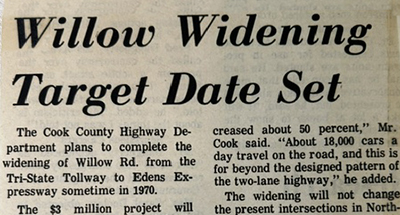
In the 1970s—as commuters shuttling between the Edens Expressway and the suburbs faced increasing bottlenecks—the state of Illinois demanded that Willow Road expand to four lanes. That started a 40-year battle between Northfield and the state, with the loudest anti-widening voice coming first from the Illinois governor (Richard Ogilvie, from 1969-73), who happened to live in Northfield. Our scrappy town fought valiantly, citing safety concerns and local quality of life. A compromise was finally reached in 2012, bringing Northfield millions of dollars for stormwater improvement; a slower, 30 mph speed limit; updated pedestrian crossings; and enhanced landscaping. To everyone’s relief, the four-lane road successfully opened in 2014, and decades of shouting ended.

Schools the heart of Northfield

A final word about our schools: that giant leap Northfield took in 1930 from a one-room schoolhouse to a gleaming showcase didn’t last. In the decades to follow, tight resources called for clever thinking.

For example, when it became clear in the 1940’s that Northfield needed a kindergarten, principal Harry Collins spent the summer of 1944 transforming a basement storage room into a classroom. Working with the school custodian, he drywalled, laid tile floors and paneled walls. That fall, Sunset Ridge opened its doors to five-year-olds.

When teachers got tired of kids eating lunch at their desks since there was no cafeteria, Collins went to the lumber yard and built twelve tables and benches, transforming a spot in the basement into a lunchroom. The parent-teacher association provided hot food.

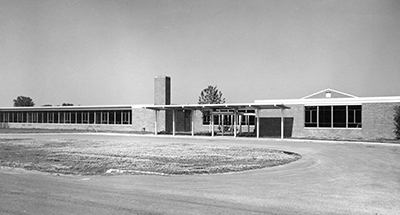
He also was a visionary when a population surge in the ‘50s led to the need for a second school. Popular thinking at the time was to give older students a place to themselves. Why not build a junior high? But Collins felt young kids needed a place where they didn’t have to worry about older kids. His vision, Middlefork School, became the first primary school of its kind on the North Shore, and a crown jewel in Northfield. Collins also enlisted the community to pitch in and help. Landscaping of the school was handled by the Northfielders’ garden club.

And that’s how things got done through the ‘40s, ‘50s. ‘60s and ‘70s as Collins inspired and drew upon the skills and talents of the community, stretching resources as best he could.

That tradition continued with his successor, Howard Bultinck. Beloved as a careful steward of the district’s tax dollars—he was known for negotiating the price of an ice cream cone—Bultinck also focused on hiring and mentoring top-notch teachers, making excellence in the classroom and cost efficiency his credos for District 29.

Bultinck’s careful approach over three decades, from 1983 to 2013, paid off in spades when his successor, Ed Stange, became superintendent. He helped the community make the wrenching decision to tear down its beloved but outdated old school. In 2018, Stange oversaw the building of a new state-of-the-art school financed without referendum. It’s now a showcase: the first LEED (Leadership in Energy and Environmental Design) platinum solar-powered net zero designated public school in the state of Illinois.

And that brings us to today. It’s no small irony that 100 years after the Chicago Tribune announced Northfield’s plans to build a stunning downtown plaza—designed by Robert Hoffman, Henry Ford’s landscape architect—our town’s Happ Road Improvement Committee has now surveyed residents, and offered their vision for Northfield’s downtown. Our village board, led by president Tracey Mendrek, has committed to seeing their recommendations through. It’s taken a century, but Northfielders will finally get a walkable, picturesque downtown.

It will happen in the same clever, unorthodox way that Northfield built its first school; formed a park district; and launched a library. The inspiration and vision isn’t coming from consultants, but from the hard work of local residents. And that’s Northfield—everything in its time. Local historian Mary Hobart always laughed about her memories of her family leaving Winnetka in the early 1950’s to move to Northfield. They all felt they had moved “halfway to the Mississippi River.”

But she and her family grew to love this backwoods town. Like thousands of others, she brought her talents and pitched in. That’s how Northfield became the village it is today.

Amidst all the upheaval and growth, one thing will never change:

When our town needed to buy a new fire truck in 1939, the village held a two-day carnival to raise funds the way only Northfield could: through bingo, roulette and liquor sales. They dedicated the event to pioneers Julia Donovan and Peter Brackendorf.

The whole town came out to honor them. What stories and memories! Peter died the following year. Julia died two years later at age 91, still living in her log cabin on Willow Road. Julia’s friend and neighbor Ruth Ahrens, who lived across the street in her family’s 1880’s farmhouse, fondly remembered her cheerful hum and whistle, long after she died.

“We were always there for each other,” Ruth said.

They are all gone now, our founding families who loved Northfield’s land, and each other. But you can still hear them if you listen.
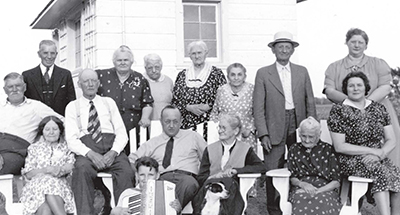
Northfield’s founding families around 1930, seventy years after first arriving: (seated, from left) Joe Braun, Lucy Brackendorf, Joe Selzer, Al Levernier, Julia Donovan, Anna Selzer and Lucia Levernier; (standing from left) George Straub, Barbara Seul, Nellie Boetsch, Maggie Selzer, Annie Seul Happ, John Happ and Coletta Selzer. Little boy kneeling in front is Chuck Reinwald.
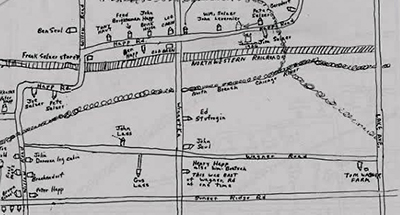
“Northfield, as I remember it”—In 1988, Charles Levernier, born in 1901 and a grandson of the founders, drew a series of maps of Northfield from 1910 to 1915. “I believe I have every home listed that was there at the time,” he said.