Northfield as You Remember
This website is not complete without you—your own memories and reflections about Northfield.
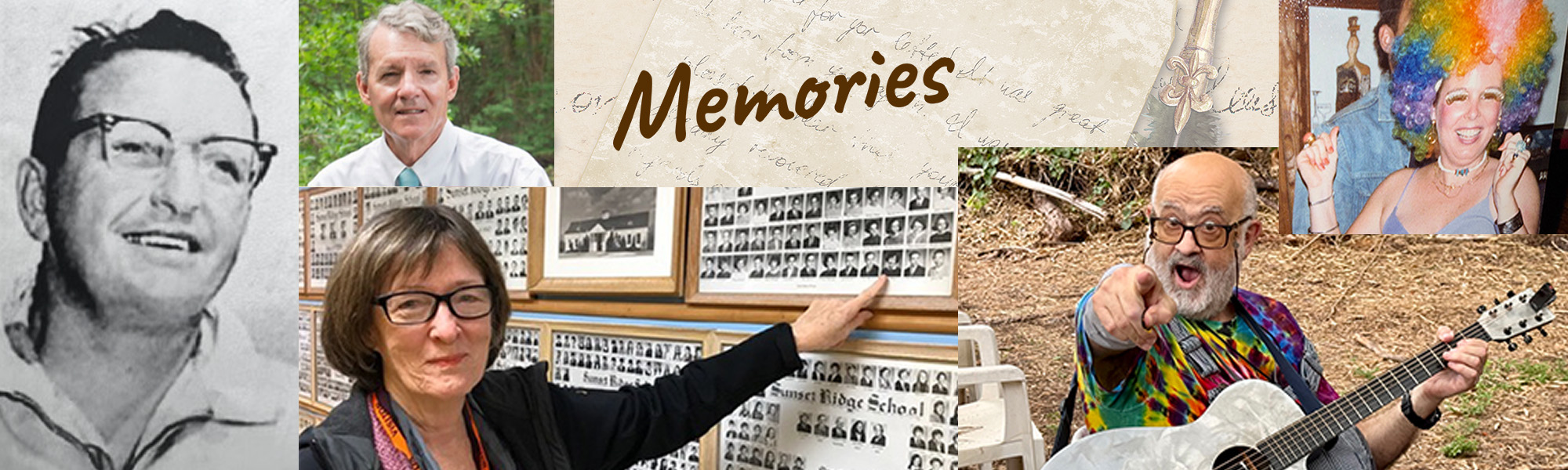
What can you share with us? What are your memories of growing up or raising a family here?
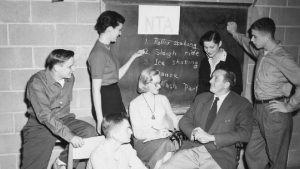
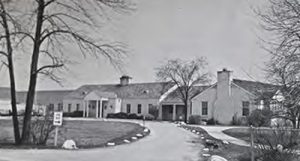
Was it spending Saturdays with friends at the Northfield Bowl? Splurging on cherry Cokes at Northfield Pharmacy? Skating or hockey at Clarkson Park? Acting in plays and musicals at Sunset Ridge? Winning goldfish at the school fair? Mr. C’s summer day camp?
You can share your memories here. And if you’d like our help writing or editing your ideas, we’re happy to do that, too.
Looking Back
Memories from Holly Wheeler Brady
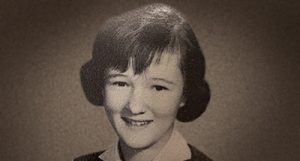
Our first guest editor is Holly Wheeler Brady, Sunset Ridge Class of 1961. Holly grew up on Pebblefork Lane. Today, she lives in Palo Alto, Calif. Holly ran Stanford’s Professional Publishing Seminars for over 15 years, and just finished her first novel.
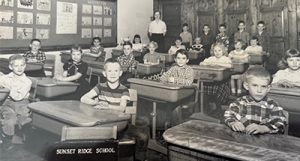
“Northfield? It was pretty nondescript,” Holly recalls. “My whole world was Sunset Ridge School. I do remember Northfield’s bowling alley, the Fix-It Shop, Bess Hardware and the new Convenience Store (a 7-Eleven) where Northfield Restaurant now stands. Oh, and there was a cornfield owned by Techny right behind our house that stretched out past Waukegan Road. Sometimes Mom would drive out there to buy fresh corn from a farm truck parked on the side of the road.”
Here’s a few more of Holly’s memories:
- “Learning how to play the recorder in third grade. We all had to do it.”
- “Learning to throw a pot in Mr. C’s art class.”
- “Selling pencils and notebook paper at the school store across from Mrs. Doepel’s third grade classroom. It’s where I learned to make change.”
- “Mr. C drilling us in bike safety in the school parking lot and giving us ‘licenses’ once we knew how to signal a right turn.”
- “Getting sprung from class to go to a Cubs game in the spring with the rest of our school patrol. for standing out in the snow to help the little kids cross Willow Road.”
- “Buying Good Humors from Bud after school. My favorite was toasted almond.”
- “Xerxes the gorilla at Brookfield Zoo.”
- “Miss Dressler (Miss Driz) coaxing the entire eighth grade to learn the operetta Red River Valley for a community performance. Lucy Becker and Bruce Flett were supposed to kiss at the climax, but they just hugged.”
- “Tuesday: soup day in the cafeteria. raisin bread. Chicken noodle soup with a PB&J sandwich on raisin bread.”
- “Spending a Saturday at the bowling alley on Happ Road. It cost 35 cents a game, which is why I know how to multiply by 35. (I can only go up to 35×3 because I never had enough energy or money to play more than three games.)”
- “Mr. Brown heaving an eraser at the head of some goof-off in the back of math class.”
- “Learning how to play ‘crack-the-whip’ on the ice-skating rink now known as Clarkson Park.”
- “Making sure I had a Chandler’s notebook for the first day of high school.”
- “Mr. C’s summer day camp. Swimming and 5-cent Dairy Queens.”
- “The Up and Down staircases at New Trier.”
- “The chick hatchingat the Museum of Science and Industry”
- “Mr. Cook and his many assignments: bug collection, leaf collection, rock collection. When yet another kid brought in a rock for identification, Mr. Cook quipped, ‘Take it for granite.’”
- “Learning to diagram a sentence in Mrs. Burgess’s class.”
- “The school fair at the end of the year. Got the pie in the face.” Oh, joy! Mr. C ran the pie-throwing booth, and he was often the one who got the pie in the face.”
- “Carnations and a Sweet Sixteen bracelet for the birthday girl. Always organized by your best friend, who sprung for the bracelet and collected money from everybody else. Each silver disk cost 50 centers, engraving as 10 cents a letter. Pat was luckier than Melissa.”
- “Freshman year at New Trier: Posture pictures for the girls, swimming in the nude for boys. What were they thinking?”
- “Madras blouses, circle pins and red Capezios.”
- “The Christmas windows at Marchall Fields, followed by lunch under the tree in the Walnut Room. Cheese soup, Fields Special sandwich, and Frango mint pie. Turned our hearts into hockey pucks.”
- “Fetal pig dissection–“and that smell!!”
- “High school graduation in two shifts–“ afternoon and evening. Several hundred white dresses shipped into the North Shore for the occasion, all (hopefully) different.”


Wrong Side of the Tracks?
The Right Place to Grow Up
Memories from Heywood “Woody” Hoffman
Clarence Seul, grandson of early Northfield settlers Henry and Marguerite, and owner of the iconic Seul’s Tavern, started out as a farmer, and like many men of the soil he did not talk much.
As a neighborhood teen working at the tavern’s package store in the 1970s, I stood next to Clarence by the front window watching while village workers repaired a section of Orchard Avenue that often flooded and seemed to need yearly repaving.
“They’ll never fix that,” Clarence said. ‘It’s always been a sink-hole. That’s where we kept the pigs.”
The family farm he grew up on once stood at Willow Road and U.S. Route 41 (now Edens Expressway), with the farmhouse located about where the westbound exit ramp off Edens curves around to meet Willow. Their farm, along with land from about seven other local families, represented civilization long before Northfield became the booming suburb it is today.
Born in 1908, the youngest son in a family of 10 children, Clarence continued to farm as he grew up, while embracing the development that motor-traffic and commerce were beginning to bring to the area.
Clarence worked at various jobs but saw what real estate offered in the burgeoning suburb, and soon had various investment properties of his own. His tavern at 1735 Orchard Lane (the present site of Stormy’s) was actually the third location where he provided food and drink for travelers, locals and residents of the nearby dry North Shore.
Sometime after the Century of Progress World’s Fair closed in 1934, Clarence bought a portion of the Victor Vienna Garden Café building and had it moved to Waukegan Road near Winnetka Avenue, where by 1939 he was operating a roadhouse. It closed when Clarence joined the Army Air Corps in 1942, serving until the war’s end.
After World War II, Seul’s Tavern relocated (around 1946) to a building by Tower Road and U.S. Route 41. That part of town was still so rural that locals would bring their shotguns and lean them in the corner of the bar, then rush out to the back cornfields to hunt when they heard pheasants calling.
The expansion of U.S. Route 41 into the Edens Highway forced the Seul family to move back into “downtown” Northfield and build the present building on Orchard Lane in 1949. There Seul’s Tavern and Restaurant remained for many years, with Clarence and his wife, Bea, handing it over to their children—Linda, Mike, Pat, Mary and Charlie—who took turns helping run it until the family decided to sell around 2003.
In the early 1960’s, Clarence also built a hardware store on Willow Road, across from what is now Clarkson Park, where his growing family lived above the retail space and his garden filled the back yard down to the creek. The Seul family was renowned for placing a telephone-poles-and-plywood bridge across the creek so their kids, and countless other students, had a rickety but welcomed shortcut to St. Philip the Apostle school.
In the mid-1960’s, Clarence built another commercial building just to the east, where an expanded Bess Hardware remains an anchor to the village that exploded around it.
About that time, the Seul family built their own home on Old Willow Road, next to an early 1900’s home (just north of the Shell gas station) where long-time resident Colette Selzer lived among a forest of huge elms and two-story-high lilac bushes.
This wonderful woman baked beautiful muffins every Halloween but couldn’t understand why most local kids would never visit her enormous gray house, set far back from the road and looking like the Addams Family mansion. Since I grew up across the street, I had no fear of sweet Ms. Selzer, and had no problem enjoying her baking prowess.
By buying Colette’s property and building just north of her dirt-floor-basement home, Clarence was able for a few more years to preserve a tiny slice of the farming history that was swallowed by the Village of Northfield.
Colette had a small, falling-down barn where the Seul family raised chickens and ducks, and kept a pony and an evil-tempered horse. Clarence had a good-sized garden, and in the back by the creek a two-acre piece of farmland allowed him to grow popcorn and gladiolas, which his children sold to passersby on Willow Road. But development marches on, and that area is now townhouses and modern homes.
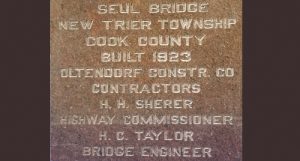
The Clarence Seuls were not the only family members who contributed to the history of the village, and the shortcut bridge wasn’t the only span famous in the area. A stone bridge in a swampy area of what is now the Skokie Lagoons was dedicated in 1923 as Seul Bridge, complete with a marble slab that lasted until the WPA renovated the lagoons during the Depression.
As for Seul’s Tavern, it remained the iconic and very busy hub of Northfield until the family decided to sell, and it thrives today as Stormy’s. I will forever be proud of Northfield and my time as part of the Seul’s Tavern family—providing friendship, cold drinks and delicious pizza on those wild softball-summer nights in the ‘70s and ‘80s. Thank you to the Seuls and congratulations Northfield!


Growing up in Northfield, the 1950s and
A Tribute to Jim Clarkson
Memories from Steve Harper
In 1950, Steve Harper’s family bought a house on 2300 Clover Lane. He was age three. He says he’ll always look back on the ten years he spent growing up in Northfield as his “Wonder Years.”
“My memories of Sunset Ridge School are a little like combining ‘Little House on the Prairie’ with Club Med,” Steve says. “That school was really a womb for us kids, and everything was taken care of!” His Sunset Ridge years also spawned a mentor for life: Jim Clarkson. “It’s the confidence Mr. C gave me, and the example he set,” Steve recalls. “Of all the men I have known who influenced how I saw the world and myself, Mr. C is second only to my father.”
Steve moved on from Sunset Ridge and New Trier to earn his doctorate in business management, becoming a college professor and author of several best-selling books on leadership and launching a company. “Mr. C has always been embedded in the way I approach my life,” Steve adds. “To this day, I can hear him encouraging me before a football game: ‘Of course you can do it!’ Whenever I’ve hit a tough fork in the road, I’ve asked myself: ‘What would Mr. C do?’”
Now retired and living in Wilmington, North Carolina, here are Steve’s memories:
In 1950, my parents (Mitchell Harper Jr. and Ellen Harper) moved from Winnetka to 2300 Clover Lane, just west of Sunset Ridge Road, when I was age three. I lived there through the 1950’s until my family moved back to Winnetka in 1961 so we could live on the edge of Lake Michigan.
In a sense, those ten years I spent in Northfield were my formative years. When I look back, I consider them my “Wonder Years.” It was a time of innocence, exploration, family gatherings and lasting friendships. In many ways, my early years were similar to Ray Bradbury’s profile of twelve-year-old Douglas Spaulding growing up in Green Town in 1928 in his book, Dandelion Wine. I like to read his classic book every decade to take me back to my days in Northfield.
Like Dandelion Wine, I remember my days of exploring numerous neighborhoods on my bike; walking along the railroad tracks; looking for Indian burial grounds; making a boat to venture down to the creek; and ice skating on the frozen overflow of the creek.
Numerous memories come from fishing for catfish at the lagoons; hearing the planes from the Glenview Naval Air Base; building forts in the woods; and hearing the bells of Bud the Good Humor man’s truck that prompted kids to run inside to get money from their parents in time to buy ice cream on a stick.
It was a time when kids in our neighborhood played kick-the-can and various other games spontaneously in our front yard.
Two things truly reflect the innocence of growing up in Northfield in the fifties. First, kids could ride their bikes in the dark to almost anywhere without fear. Second, the older students at Sunset Ridge School were “crossing guards” who wore special white diagonal belts across their chests to help students cross Willow Road at the Sunset Ridge Road intersection. Can you imagine kids having that responsibility today?
And Sunset Ridge School? Unless a child went to some other school in their early years, then any childhood memories, or parents’ memories, have to include Sunset Ridge. I truly believe that school had a culture that fostered self-development, personal worth, collegiality and learning. Sunset Ridge had outstanding teachers at all educational levels, beginning with kindergarten and continuing all the way through eighth grade. And, for many years, Jim Clarkson—also known as “Mr. C”—reflected those values.
Of all the men I have known who influenced how I saw the world and myself, Mr. C is second only to my father. He helped decades of students learn about so many things. He taught art, coached our sports teams, drove the school bus to various events, taught kids how to square dance, and helped them learn about life and themselves.
Mr. C’s lasting concern for the kids he interacted with was evident years later, after many of his students became adults. He always remembered them and their names! I was delighted to see Clarkson Park as one way Northfield continues to honor a great man.


“Northfield Is In My Heart, and Always Will Be!”
Memories from Yvonne Puryear Hurlbutt
Yvonne’s family moved to Northfield in 1958 when she was age five. Her parents built a home at 1883 Bosworth Lane where she and her brother Rick, two years older, grew up. Their dad Richard was a TV cameraman who was then promoted to technical director for the ABC network, and he traveled around the country to shoot legendary shows like “American Bandstand” and performances by Elvis and the Rat Pack in Las Vegas. Once, when her dad was at the White House to shoot a documentary, he was bending over to adjust a cable and bumped into an onlooker. He turned out to be JFK. Another time, while her class at Sunset Ridge School was watching a film about Argonne National Labs, a classmate shouted, “Hey, Audie (her nickname), isn’t that your dad in the film credits?” “My dad was always on the road,” Yvonne recalls. “He loved what he did. In fact, he’s a big reason I’ve always been a stickler for being on time. You shouldn’t be late to air a TV show!”
Yvonne and Rick began their education at St. Philip the Apostle School. In third and fifth grade, they transferred to Sunset Ridge. While their dad traveled nonstop, their mom managed life at home. “I loved Sunset Ridge,” Yvonne says. “In fact I’m still close with my grade school BFF’s. We always walked to school or rode our bikes. As the new kid in third grade, I had to develop interpersonal skills that have served me all my life.”
Some of Yvonne’s fondest early memories include summers at Jim Clarkson’s day camp. Two highlights were archery and tennis. She also loved the freedom of growing up on Bosworth Lane where neighborhood kick-the-can games were popular; and she and Rick could leave the house all day, carefree and ready to create their own fun.
“We had so much freedom!” she says. For example:
The Creek: “In the summer we’d wade in the (Middlefork) creek and sometimes even swim! These bugs at times would cling to us when we came out, but we would never tell our parents. We’d borrow a cigarette and burn them off! Then, in the winter, we’d go skating on the creek, heading north all the way from Bosworth to where I live today, near Meadowbrook Drive. Of course we’d sometimes break through the ice and fall in– that was part of the adventure!”
Ice Skating at Clarkson Park: “Did you know Northfield has had three different warming houses? I remember the first one, in the late fifties. It was a little wooden shack painted dark green that stood on the northwest corner of the park. It fit about four people, with a single light bulb hanging from the ceiling. That was it! I was so glad when a second warming house was erected in the sixties. It was located where the third and newest shelter, Lustig Lodge, is today. That second lodge seemed just huge to me. It even had an ‘in’ and ‘out’ door! And no hanging lightbulbs! It offered no food or heat; but we all felt like we were moving up!”
A 1971 graduate of New Trier West, Yvonne in 1976 married New Trier East alum Bill Hurlbutt, and they settled in Northfield where they raised Alex and Ryan in a home they purchased on 260 Bristol. Yvonne pursued a fast-paced career in human resources; and she tragically lost her husband in 2008 to a heart attack. She says our community rallied around her, especially Northfield’s chief of police, Bill Lustig. “He called me every day for two-plus weeks just to make sure I was okay,” she says.
Today, Yvonne is retired and enjoying a whole new stage of life as a grandmother to four-year-old Maddie Rae. She now lives in her third Northfield home on the far north end of town on Valley View Road.
For several years, she lived in Wilmette, but her hometown lured her back. “Northfield is in my heart, and always will be,” she says. “It was a wonderful place to grow up, raise a family, and now retire. It’s smaller. More personal. When I go to Market and Music at Clarkson Park, I’ll run into ten people I know. I’m very happy here.”
Yvonne smiles about one memory from the early 1990’s, when she was a busy working mom, happily married and raising two young boys. The word around town was there would be no school fair that year at Sunset Ridge. “No one wanted to chair the fair,” Yvonne recalls. “I was so upset! It was one of my best memories growing up in Northfield. We just had to have a fair!” “
So I told the school, “‘I’ll do it!’” And, as busy as she was, Yvonne teamed with Northfield’s Nancy Whiteman to create another magic memory for the whole community.
“It was wonderful, just getting the fair back on track, and keeping the tradition going for at least another decade,” she recalls. “That fair was always such a special celebration in Northfield. And all it took was finding two women who were busiest to help keep it going!”


Growing up in Northfield,
A Tribute to the Firefighters
Memories from Heywood “Woody” Hoffman
This is a second memory written by Heywood “Woody” Hoffman , a retired journalist who grew up in Northfield in the ‘60s and ‘70s, and worked as a young man at Seul’s Tavern.
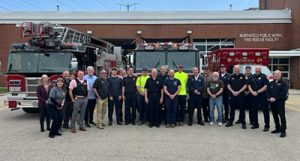
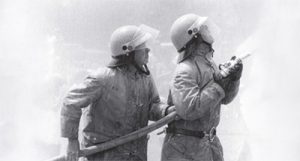
For much of the first 50 years of Northfield, generations of area residents volunteered as firefighters—responding to emergencies and serving as examples of the hard work required to support our young village.
A professional and completely modern Fire Department developed as Northfield expanded, but even into the late 1970s, most responders were volunteer amateurs trained by a handful of full-timers.
As a child in the early 1960s, I knew the siren blaring from Village Hall meant neighbors would be jumping onto the fire engine, and all the nearby kids would rush toward the station at Walnut Street and Willow Road to watch them take off for emergencies unknown.
I got a closer look at the volunteers—and even had my small role—in the mid-1970s as a young bartender at Seul’s Tavern (now Stormy’s), at 1735 Orchard Lane, one block away from the police, fire and village headquarters.
My part was simple. When the siren or a chorus of beepers went off, any volunteers relaxing at the bar would rush out the door. My job was to put a coaster over their drinks and protect their keys or loose change while they answered the call.
If it was a minor problem, they might return quickly while the beer was still cold. Any longer absence meant I would set up fresh drinks, on the house, when they got back and filled us in on the latest. Sometimes they were teased about chasing a false alarm or spraying down an out-of-control barbeque grill.
But sometimes the call was a real fire or a serious accident, and it would be hours before these men came back, tired, dirty and spent, with not much to say.
And one time, I and a handful of locals got a close-up look at what those volunteers were prepared to do.
As I got off a shift late one afternoon, the siren summoned volunteers from the after- work crowd. After we watched them head out, the word spread that a real fire was burning in the Willow Hill shopping center—directly across Orchard Lane from Seul’s Tavern!
I and a group of eager witnesses could see smoke coming from the two-story building at the far south edge of the parking lot, where a few rental apartments were on the top floor. We hurried over and could see the fire truck already set up along the Mt. Pleasant Lane side of the block-wide building.
We couldn’t see any firefighters at first, but we knew they were inside because ladders poked up to the second-floor porches from both the parking lot and the Mt. Pleasant side, and at least one hose was working.
Thick black smoke was pouring from the porches overlooking the parking lot, about 30 yards from us. Suddenly, with a big “whoosh” we all felt, the smoke was replaced by a wall of huge flames.
Just then someone yelled out they thought a woman resident might be trapped, but all we could do was stand and stare.
Then it all happened in front of our eyes, like a movie scene.
A lone firefighter, carrying a woman over his shoulder, burst through the wall of flames and jumped onto a ladder, seeming to slide down it to lay the victim on the grass at the edge of the lot.
Paramedics rushed to take the woman away as the firefighter, with ash-covered gear, face-mask and helmet, sprawled on the ground sucking in deep breaths.
Other firefighters ran over with oxygen and pulled off his headgear.
It was Louie Dini, a volunteer who minutes before had been sipping a draft in Seul’s after his shift in the Village Public Works Department.
Louie Dini, a quiet, hard-working guy who ran a “Rubbish King” service on weekends, helping homeowners clean up yard waste and construction debris.
Louie Dini, an absolute hero.
I never learned the woman’s name but I heard she recovered. Louie was checked out by paramedics and was okay, and able to get a few fresh beers that night on the house to replace the one that got warm.
Thinking back on that day, I shouldn’t have been surprised at Louie’s bravery—because many years before I had seen Northfield Fire Department volunteers quietly show dedication and strength on another call.
In the mid-1960s, freight tracks ran directly behind my house on Old Willow Road, and I was crazy for them. I always listened for the rumble of the oncoming trains, and could scramble through the fence in our backyard to watch them from a closer, but safe, distance.
When I was 8 or 9, the sirens blared and the volunteer firefighters responded to a fatal train-verses-car crash at Willow Road, a block from my house. A woman in a Volkswagen Bug apparently tried to beat the train but didn’t, and it pushed her mangled tiny car for hundreds of feet north along the tracks—almost to my backyard.
I was on the scene quickly, amazed at the wreckage and the huge, idling engines. I was told that a woman was killed, but was too young to grasp the weight of the tragedy.
With the scene winding down I walked along the tracks toward my house, as three firefighters walked slowly on the track-bed toward me.
One man was on either side of the tracks, while the third walked in the middle carrying a bucket. They all wore stained rubber gloves.
They were silent as they passed, eyes scanning the ground, and occasionally would bend down to stoically retrieve a small portion of the victim, to be respectfully interred.
As young as I was, I was only dimly aware of what was being done, but I could tell it was important and sad. Now I know it was an early testament to what it took to be a volunteer for your fellow citizens in Northfield.
Remembering My Dad
Memories from Kathleen Clarkson
Kathleen Clarkson, daughter of Jim Clarkson, is a retired teacher with degrees in Elementary Teaching and Early Childhood Special Education. She is also a state- certified Massage Therapist, and lives in Hemet, California.
Happy 100 years of history-making, Northfield!
It is personally moving to me that Clarkson Park is the site of your milestone celebration on August 22nd. I am the youngest of two Clarkson daughters who grew up in Northfield in the ‘50s and ‘60s. Back then, I was known as “little C.” My older sister Christine was “big C.” My parents, Jim and Marilyn, were affectionally called “Mr. C” and “Mrs. C.”
Many parents like mine in the late ‘40s and ‘50s were glad to put World War II behind them. They wanted to move forward, and find a place to call home and raise a family. It was in that spirit that they helped Northfield grow from a small rural community into a suburban village.
When my parents purchased their home at 257 Jeffrey Lane in 1949, land next door sat vacant for years. At the end of our street, several more acres of open land sat untouched for decades. That’s how I remember Northfield. As a child growing up, we had trees to climb and open spaces to explore. While most neighboring towns were built-up by the mid-‘50s, open fields in our town were plentiful. It was a safe community and our parents let us roam.
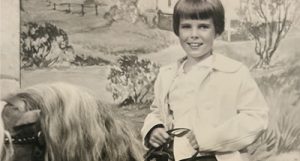
One thing that made our community unique was the fact that the descendants of early farm families didn’t leave. While a few families continued to farm through the ‘40s and ‘50s, most farmland was sold by the mid-‘50s. It must have been so hard for those founding families to separate themselves from their land. But they continued to live in Northfield for generations. To their credit, they persevered by bringing a “can-do” spirit to new endeavors. They were among Northfield’s first entrepreneurs, establishing businesses, restaurants and serving in local government.
I grew up alongside these great-grandchildren of early pioneers. Our families became intertwined with one another as we moved forward into the modern era. Children of the Happ’s, Seul’s, Metz’s, Selzer’s and Ahrens’ were my contemporaries, and we got to know each other at school, church, park district activities and summer camp. We learned and played together on the same land owned and farmed by their ancestors.
That close connection to the land, and a commitment to helping neighbors, describes the Northfield I knew. Today, as the village continues to modernize, I think those same values are the true spirit of your community.
Schools our big point of pride
The most important thing about Northfield? We loved our schools. Our curriculum in the ‘50s and ‘60s was “comprehensive”—meaning that our elected school boards worked closely with our teachers and principal Harry Collins to provide a top-notch K-8 experience that combined academic learning with art, music and physical education classes. Mr. Collins, was a “progressive,” and committed to this educational approach. He helped make our Sunset Ridge years exceptional. Mr. Collins was genuinely kind, yet firm, and well-respected.
I played flute in the school band, participated in the school choir, and was a cheerleader. I am grateful we were introduced to North Shore musicians who came to our school and treated us to wonderful classical music. They inspired many kids to play instruments in elementary school and beyond. Other favorite memories include the school fair that our moms helped organize and run each year. I remember carrying around reams of tickets so I could enter booths and win a prize like a goldfish to take home.
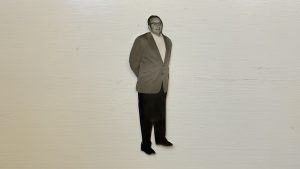
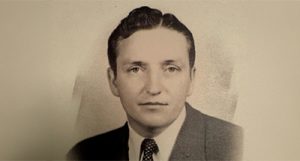
Unlike most other Northfield kids, I was lucky because each day at school, I got to see my dad, Mr. C. Whenever there was an opportunity, I’d slip into his office, give him a quick hug and then head back to class. To me, Jim Clarkson was just “dad.” But he was a larger-than-life figure in our school and our community. My dad was a true “renaissance man”—he taught art and physical education classes, was the football coach, bike safety and health instructor, and social dance teacher.
I have so many favorite memories of my dad at Sunset Ridge. One that many boomers might remember is a bi-yearly nighttime gym show we put on for our parents. We called it the “Olympics” to show what we were learning in our P.E. classes. I remember entering a darkened gym with flashlights, marching in unison, and singing a song written by my dad to the tune of a United States Army song, the “Caisson Song.” The tune started out: “We are here to tell the story as we march along, about the way the P.E. makes us strong!”
Social dancing a rite of passage
Another cherished memory was social dancing, taught by my father in our school gym. He also taught square dancing to the 6th , 7th and 8th grades. On Friday evenings, our school gym transformed into a dance space where 7th and 8th grade students learned to dance the box step, fox trot and cha-cha-cha. A professional social dance instructor was hired to teach the kids along with my dad. My mom would sometimes fill in as her substitute. I am grateful for those dance steps I learned as they were useful later in life.
Starting Northfield Park District
My dad graduated from the University of Indiana in the late 1940’s with a degree in Physical Education, and later got a certificate in Parks and Recreation. So, in 1957, while he was teaching physical education at Sunset Ridge, he was offered the chance to also take on a part-time management position for the newly created Northfield Park District. He ran the park district for 23 years out of our basement at home before he retired.
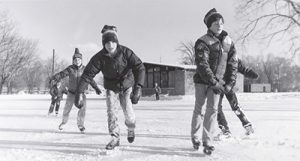
One of my dad’s park district responsibilities in the winter was flooding a section of open field just south of Willow Road to create an ice skating rink. He worked with several other dads to regularly groom the ice rink and hold ice skating games and races there during the winter. Most Northfield kids looked forward to skating there during the long winters.
Years later, that same field became “Clarkson Park.” Even after he retired, my dad continued to run the annual Easter egg toss at Clarkson Park, which delighted him.
Clarkson's Day Camp
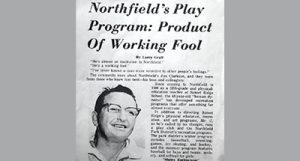
For a fun-filled eight weeks in the summer, about 100 Northfield kids attended Mr. C’s Northfield Play Club. It was almost a rite of passage for generations of kids. How my father had the energy to run a camp after teaching full-time at Sunset Ridge and part- time managing a park district, I’ll never know. But he was able to pull it off for 27 years!
My father employed many Northfield teens and young adults as counselors over the years. He had a great sense of humor and liked to tell jokes. He would often lead us kids in boisterous songs on the bus as we rode to various places–songs like, “There Were Three Jolly Fishermen.” Counselors sang along with us, and many parents also learned the songs from a booklet my dad sent home with campers.
The emphasis at camp was on fun, and that was plentiful! Some of the amazing adventures I remember included learning to swim in Lake Michigan; attending Wrigley Field Cubs’ games; going to Riverview Park; fishing in the Skokie Lagoons; and camping overnight in the Illinois State Park Preserves, miles away from Northfield.
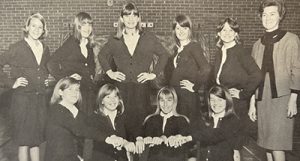
A big hit at our overnight campouts was Mrs. C’s “bug juice”—diluted orange and lemon juice with the pith floating around. I also remember the scary stories my dad would tell as we sat inside the state park lodge by a roaring fire. Sometimes, for added effect, a counselor hid outside the lodge and made spooky noises, timed with the story. Campers, even if a little scared, usually looked forward to these stories! We camped in a very wooded area, and my dad would have us look for certain things among the plants and trees in the forest. There was even a contest to see who could identify or collect the most items.
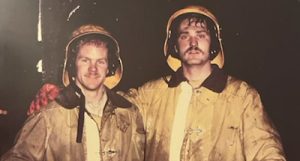
Back in Northfield, my dad had a balanced approach to planning each day’s camp activities. There were arts and craft projects; neighborhood pools for swimming lessons; and lots of sports activities. Mr. C’s Play Camp was the highlight of many childrens’ summers.
Looking back, I am filled with an overwhelming sense of gratitude to those original farm families whose love for the land saved Northfield from becoming one big, sprawling suburb. I am also grateful to the newcomers, like my parents, who wanted green spaces for their children to play. Both generations helped shape Northfield into what it is today.
What made Jim Clarkson special
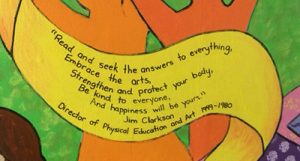
And my dad? What I remember most—whether at school, summer camp or the park district–was his commitment to everyone: kids, parents and staff. He was a guy who just had boundless love, commitment and energy. I think he was amazing in his ability to handle so much. Despite the intensity of everything he was juggling, what I admired most was this incredible sense of humor he brought to everything. That was my dad!